A new way to explore the web with AI Mode in Chrome
AI Mode in Chrome
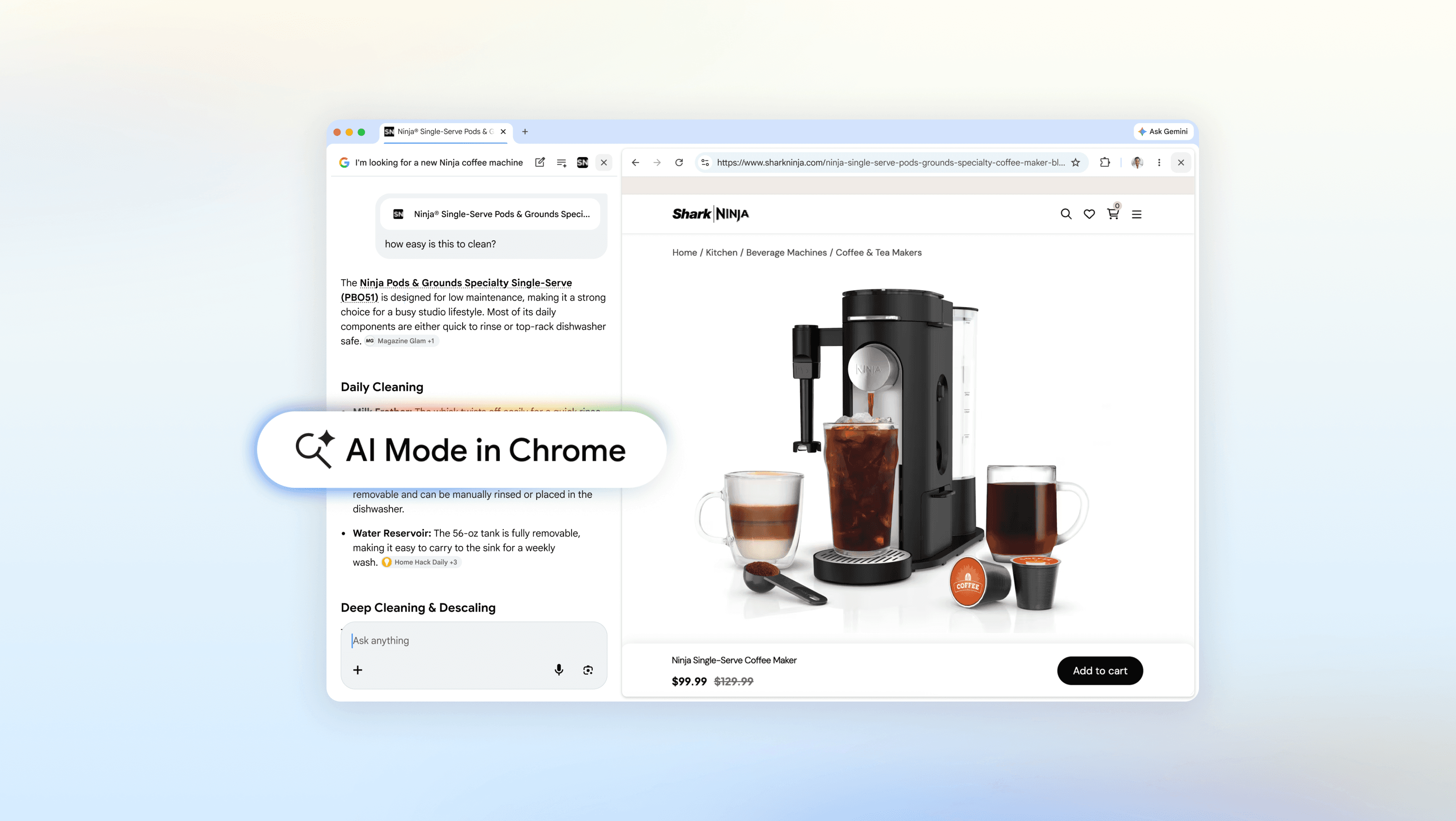
Get fast, seamless help while you explore the web with a new AI Mode experience in Chrome — without switching tabs.
Your browser does not support the audio element.
Finding information online can often feel like a constant game of “tab hopping.” You start searching in one tab, then open another to follow a specific idea or topic. Then you have to switch back to Search to keep your train of thought going.
Our new Search experience in Chrome can change that. Today’s upgrades for AI Mode in Chrome make it easier to access and engage with content and dive deeper into what you find — all without losing your place or needing to switch tabs. It’s a more fluid way to discover and learn from the vast range of perspectives across the web.
Introducing a better way to explore the web
Now, when you're using AI Mode on Chrome desktop, clicking a link opens the webpage side-by-side with AI Mode. This makes it much easier to visit relevant websites, compare details and ask follow-up questions while still maintaining the context of your search.
Let’s say you’re shopping for a coffee maker that fits in your cozy apartment and can make lattes. Just head to AI Mode in Search, describe what you’re looking for and you’ll get a range of options that fit your criteria. See a model you like? Open the retailer’s site alongside AI Mode and ask specific questions, like, "How easy is this to clean?" Using context from the page and from across the web, AI Mode will share the insights you’re looking for, helping you make an informed decision with ease.
Or, perhaps you want to learn about the different McLaren Racing teams and how their pit crews train. With AI Mode in Chrome, you can easily explore related pages, like McLaren Racing’s official site, without breaking your flow. AI Mode is ready to handle your follow-up questions in real-time, creating a fluid process that helps you better digest each site you visit and uncover the next page to explore.
Our early testers loved that they didn’t have to constantly switch tabs to get help with a comprehensive article or a long video. And they found that having both Search and the web side-by-side helped them stay focused on their tasks while exploring useful web pages.
We’re also making it possible to search across the Chrome tabs you’re already exploring. On Chrome desktop or mobile, you can tap the new “plus” menu in the search box on the New Tab page (or the existing plus menu within AI Mode) to select recent tabs and add them to your search. You aren't limited to one type of input, either: you can now mix and match multiple tabs, images or files (like PDFs) and bring that context into your AI Mode searches.
Maybe you’re researching local hiking trails and have several related sites open already. You can add those tabs to your search and ask for similar kid-friendly trails in a different location.
Or, if you’re studying for a statistics midterm, you can bring in context from open tabs with your class notes, lecture slides and academic papers and ask for more examples to illustrate a tricky concept. AI Mode will use those tabs to provide a tailored response and suggest more sites to explore.
Finally, powerful tools in AI Mode, like Canvas or image creation , are accessible wherever you see the new plus menu in Chrome.
All of today’s updates are now available in the U.S., and we’ll expand soon to more places around the world.
Check your inbox to confirm your subscription.
You are already subscribed to our newsletter.
You can also subscribe with a different email address .
Key takeaways
- AI Mode in Chrome enhances browsing efficiency by allowing simultaneous access to information and contextual questioning.
- The innovation could boost e-commerce in Brazil by facilitating product research and comparison.
- Maintaining a train of thought without tab switching may increase user productivity, especially in an information overload scenario.
Editorial analysis
The introduction of AI Mode in Chrome represents a significant advancement in how users interact with the web, especially in a context where efficiency and agility are essential. For the Brazilian tech sector, this innovation could stimulate the development of solutions that integrate artificial intelligence more seamlessly into browsing experiences. Brazil, with its growing internet user base and expanding e-commerce market, stands to benefit greatly from tools that facilitate product research and comparison, as demonstrated in the coffee maker example.
Moreover, the ability to maintain a train of thought without the need to switch between tabs could positively impact user productivity. This is particularly relevant in a country where many professionals still face challenges related to distraction and information overload. Implementing a system that allows real-time questioning and access to contextual information could help mitigate these issues, promoting a more focused and efficient browsing experience.
What to watch for next is how this functionality will be adopted by Brazilian users and how local companies can integrate their platforms into this new experience. Collaboration between software developers and e-commerce platforms could result in a synergy that not only enhances user experience but also boosts online sales. Additionally, the evolution of AI Mode could open doors to new applications of AI in everyday life, from personal assistants to more sophisticated recommendation systems.
Finally, it is important to consider the privacy and security implications that come with the use of AI in browsers. With data collection aimed at providing more accurate responses, transparency regarding how this information is used will be crucial to gaining user trust. Brazil, with its data protection legislation such as the LGPD, will need to ensure that these innovations respect consumer rights and promote a safe digital environment.
What this coverage includes
- Clear source attribution and link to the original publication.
- Editorial framing about relevance, impact, and likely next developments.
- Review for readability, context, and duplication before publication.
Original source:
Google AI BlogAbout this article
This article was curated and published by AIDaily as part of our editorial coverage of artificial intelligence developments. The content is based on the original source cited below, enriched with editorial context and analysis. Automated tools may assist with translation and initial structuring, but publication decisions, factual review, and contextual framing remain editorial responsibilities.
Learn more about our editorial process